
Home / Media & Blog / Three floods, one monsoon
Long read · Climate & disaster responseThree floods, one monsoon, and the lifeboats we are still not filling.
Assam in August. The Bhotekoshi on the 26th. Bihar through September. The warming that makes a season like this one more likely stopped being a forecast some time ago — and the harder problem now is not disbelief. It is the hour between believing and acting.
Humrahi Foundation · 17 September 2026 · 13 minute read
What this piece argues
- A warmer atmosphere carries about 7 per cent more water vapour per degree of warming. The IPCC’s Sixth Assessment finds heavy precipitation has intensified over most land regions, with human influence the likely main driver.[1][2]
- Widespread extreme rain events over central India tripled between 1950 and 2015, and Hindu Kush Himalayan glaciers disappeared 65 per cent faster in 2011–2020 than in the decade before.[4][5]
- The Titanic did not break the lifeboat law. She exceeded it. The law was eighteen years old and stopped counting at 10,000 tons; she measured 46,328.[6][7]
- And the boats that were there went into the water about 40 per cent empty — roughly 467 seats that existed, were legal, were lowered, and carried nobody.[8]
- That second failure is the one we keep repeating. Our own Bihar appeal has been open since 13 September and, as of this morning, has received nothing at all.
Three floods in one monsoon
We are a small foundation working out of Siliguri, in the corridor of land where Nepal, Bhutan, Bangladesh and north-east India are all a few hours’ drive away. In an ordinary year that means we respond to one emergency and read about the rest. This year the work came in three.
They were not the same event. One was a river basin filling the way it has filled for centuries, only harder. One was a mountain failing above a river. One was a plain draining water that fell in another country. What they share is a season, and a set of odds that have been moving underneath all three for decades.
The water goes, the silt stays
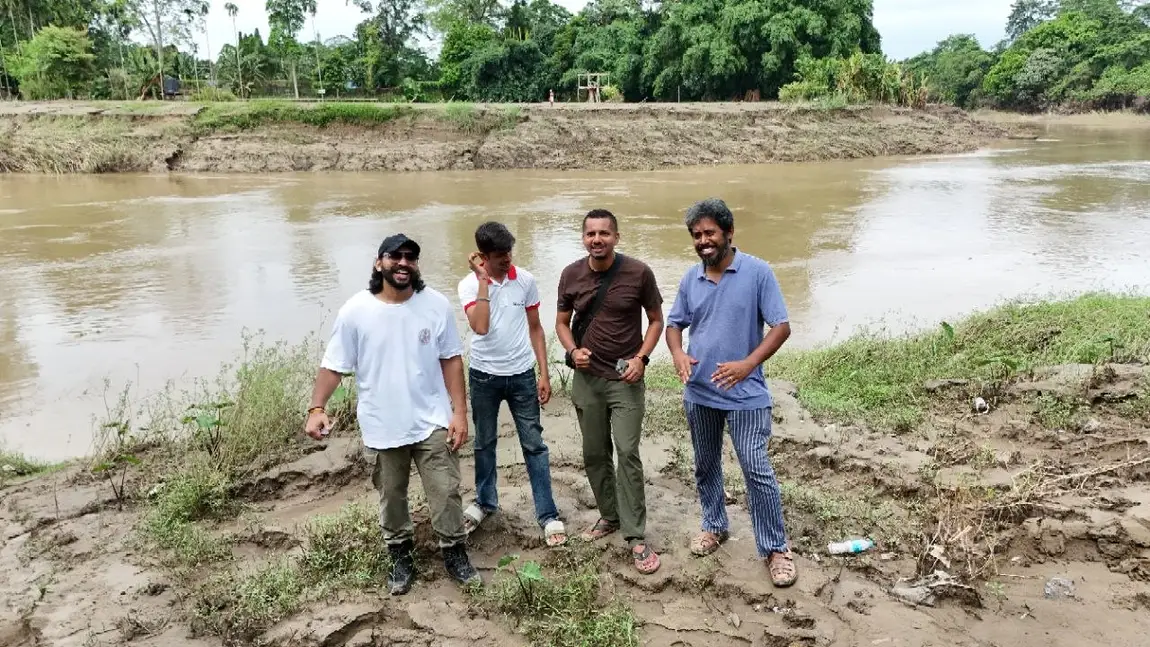
Our team worked in Sivasagar and Charaideo after the water had already receded. Relief kits reached more than 300 families with Nine Story Foundation, and the longer stretch of the work was clearing roadside plastic with Midway Journey and staying on the distribution-site cleanups after the emergency phase ended.
Closed. The page is a record now, not an appeal. What we saw →
A mountain, then a river
At about 08:37 Nepal time a glacier ice avalanche came down in the Gyirong area on the Tibetan side of the border. Debris blocked the Lhende Khola; when the blockage gave way the water and sediment ran down the Bhotekoshi. We loaded in Siliguri on 31 August and handed over at holding sites in Trishuli and Rasuwa. KarmaYog Foundation, a Nepali organisation, led that distribution; the register is theirs and not ours.
Phase one done. The field report →
The plain that takes it all
The Bihar Disaster Management Department’s bulletin, as reported on 11 September, counted 46.88 lakh people affected across 15 districts and 88 blocks, 11,255 people in relief camps and the Ganga running 2.12 metres above the danger mark at Sultanganj. Four days earlier the same count was roughly 27 lakh across 13 districts.[9]
Open, and we have not been there. The appeal →
Line those three up and the geography stops being a coincidence. The rain that fills the Brahmaputra, the ice that sits above the Bhotekoshi and the Nepali catchments that drain south into the Ganga are all one system, and it is a system with a thermometer in it.
What warming actually does to rain
The mechanism is not complicated and it is not disputed. Warm air holds more water vapour — roughly 7 per cent more for every degree Celsius, which is a nineteenth-century result, not a modelling assumption. Warming does not conjure storms out of nothing. It loads them. When the conditions for heavy rain do arrive, there is simply more water available to come down.[2]
The IPCC’s Sixth Assessment states the consequence plainly: the frequency and intensity of heavy precipitation have likely increased over a majority of land regions with good observational records, and human influence is likely the main driver of that intensification.[1] The report also puts it in the language that engineers and district officers actually use. A rainfall day that used to arrive once in ten years is now about 1.3 times as likely, and about 7 per cent wetter, at one degree of warming.[1] 2024 was measured at roughly 1.55 degrees above the 1850–1900 average, the first calendar year over 1.5.[3]
In this catchment specifically
The regional picture is sharper than the global one. Work led by M. K. Roxy at the Indian Institute of Tropical Meteorology found a threefold rise in widespread extreme rain events over central India between 1950 and 2015, driven by increasingly variable monsoon westerlies pushing surges of moisture in off the Arabian Sea.[4] The total rainfall of a monsoon has not changed much. Its delivery schedule has. The same water arrives in fewer, heavier events, which is precisely the pattern that drainage designed for a gentler distribution cannot take.
Above Nepal the change is in the ice. The ICIMOD assessment of the Hindu Kush Himalaya found glaciers there disappearing 65 per cent faster in 2011–2020 than in the previous decade, with up to 80 per cent of current volume projected to go by 2100 on present emissions.[5] Ice that retreats leaves behind slopes that were being held together by it, and lakes that were not there before.
The honest limit of all that
None of this says that warming caused the avalanche above the Bhotekoshi on 26 August, or the Ganga’s level at Sultanganj this month. Attributing a single event is a separate piece of science with its own methods, and for these three floods no such study has been published. Anyone telling you otherwise this soon is guessing.
What the evidence describes is the deck, not the hand. The odds of a heavy-rain day have moved, measurably, in the direction of heavier. Whether any particular flood was one of the extra ones is usually unanswerable and, for a family in a relief camp, beside the point.
Nobody on that bridge was ignorant. They were sailing to a rulebook written for a smaller ship, in an ocean that had stopped matching it.
The most expensive near-miss in the history of being sure
Everyone knows the story, and the version everyone knows is the least useful part of it. Arrogant people built a ship, called it unsinkable, hit an iceberg and got what was coming. It is a satisfying story because it lets the listener off. We would not have been that stupid.
The record is duller and considerably worse.
The word had a qualifier, and the qualifier went missing
Nobody official ever said “unsinkable” flat out. The phrase came from a trade magazine: in 1911 The Shipbuilder ran a special issue on the Olympic-class liners and described the watertight-compartment arrangement as making the vessel “practically unsinkable”. The White Star Line’s own promotional copy was hedged too — “as far as it is possible to do so, these two wonderful vessels are designed to be unsinkable.” Harland and Wolff, who built her, have always insisted they claimed no such thing.[10]
Between the trade press and the dinner table, the qualifier fell off. By the time the word reached the passengers it had become a flat statement of fact, and several survivors later testified that this was exactly what they had understood. A carefully hedged engineering claim had been sanded down into a promise nobody had made.
That trip is not a historical curiosity. It is what happens to climate language every day, in both directions. “A one-in-a-hundred-year flood” is a statement about a one per cent chance each year, on a distribution that is currently moving — and it gets heard as “not in my lifetime.” The hedge is doing the opposite work, and it still gets stripped.
The lifeboats were legal
Here is the part that should be uncomfortable. The Titanic was not under-equipped by the standards of her day. She was over-equipped. The British Wreck Commissioner’s report states it in so many words: the ship “carried boat accommodation for 1,178 persons, a number far in excess of the requirements” of the Board of Trade table then in force.[6]
Those requirements came from rules made under the Merchant Shipping Act 1894. The table set a floor of sixteen boats under davits for every vessel of 10,000 gross tons and above — and then it stopped. There was no further gradation, because when the table was drawn nothing much larger than 10,000 tons existed. Titanic measured 46,328 gross tons. She carried twenty boats against a requirement of sixteen, and her owners could accurately describe themselves as exceeding the safety regulations.[7]
Eighteen years passed between the rule and the ship. In those eighteen years the ships quadrupled and the table did not move. Nobody was corrupt and nobody was stupid. A number that had once been generous simply stayed where it was while the world it described walked away from it.
And then the boats went out half empty
The second failure is the one that is genuinely hard to read about, because it happened after everyone knew.
The first boat lowered, number seven, went down the side with 28 people in a boat built for 65. Boat number one left with twelve people in a boat for forty. Across the night, roughly 711 people came off in boats certified for 1,178. About 467 seats — seats that existed, that were paid for, that were legally required to be there, that were successfully launched — went into the North Atlantic carrying nobody.[8]
The reasons were not cowardice or malice. They were ordinary. The ship was lit and warm and very nearly level, and the boat swinging over eighteen metres of black water was obviously the less safe place to be. The first boats went at one in the morning into a situation that did not look like an emergency. Some officers were unsure the davits would take the weight of a full boat. Passengers below decks could not get up to the boat deck in time. Every one of those is a reasonable, explicable, locally sensible decision, and they add up to four hundred and sixty-seven empty seats.
Two years later the first international Safety of Life at Sea convention required lifeboat places for every person aboard.[11] The rule changed afterwards. That is the only part of this story that happens reliably.
Four things that carried over
The table that stopped counting
Embankments, culverts, urban drainage and dam rule-curves are designed against return periods computed from the historical rainfall record. When the record stops describing the rain, the structure is still compliant and still fails. Assam’s embankments and Bihar’s drainage are not scandals of corruption so much as tables that stopped at 10,000 tons.
The qualifier goes missing
“Practically unsinkable” lost its first word on the way to the passengers. “One-in-a-hundred-year event” loses its arithmetic on the way to the householder. Hedged technical language does not survive the trip to the people who have to act on it, and the loss is never in the safe direction.
The boats go out half full
Relief funding tracks footage, not need. An appeal with video behind it fills in three days; an appeal for a district nobody has filmed can sit fully open, fully legal, fully launched, and carry nobody. The seats are not missing. They are unoccupied.
The rule changes afterwards
SOLAS came in 1914, after 1,500 people had made the case. The pattern holds: the standard is raised once the failure is undeniable and paid for. The only variable anyone controls is how much of the response happens before that point rather than after.
We are one of the half-empty boats
It would be easy to end this on governments and design codes. The more honest ending is closer to home.
Our Nepal response worked. The convoy loaded in Siliguri on 31 August, crossed after several days of delays, and the goods were handed over at holding sites in Trishuli and Rasuwa on 10 September. Nearly all of the money that paid for it arrived within about three days of a single video going up, and very little arrived after that. The need did not change in those three days. The attention did.
Then there is Bihar. The appeal page has been open since 13 September. It carries the official figures with their sources, the dates, an explicit statement that we have not been there and have no partner there yet, a ring-fenced fund, and a written undertaking to refund every rupee if we cannot get there within sixty days. It is, by our own standards, the most carefully built thing on this website.
As of this morning it has received no donations at all. Not a small number. Zero, from a page that has everything a donor could reasonably ask for.
Nobody decided that 46.88 lakh people did not matter. There was simply no photograph, no reel, no moment that made anyone look — and a launched, seaworthy, fully compliant boat sat in the water with nobody in it. We built the boat and did not fill it. That failure is ours, and it is the same failure as 1912’s, at a scale we can actually do something about.
Which is the small, unglamorous point this whole piece exists to make. The argument about whether the climate is changing was settled by people with instruments a long time ago. The argument that is still live is the one that ran on a lit, level deck at one in the morning: whether anybody gets into the boat while there is still time, or waits until the angle of the floor makes the decision for them.
The boat that is currently empty
Assam is closed and Nepal’s first phase is done. The appeal that is open, and unanswered, is Bihar. Gifts through these buttons are tagged to the Bihar Flood Relief 2026 fund, which was opened on 16 September 2026, so they are reported separately from our general donations rather than disappearing into them.
Or give another amount. Payments are handled by Seva Stack. Donations to Humrahi Foundation carry 50 per cent tax exemption under Section 80G and the receipt is issued automatically. If we cannot get to Bihar within sixty days of the appeal opening, every rupee is refunded — that undertaking, and the full reasoning behind opening an appeal before we have been anywhere, are set out on the appeal page. Our registrations, accounts and reports are on the transparency page.
Not in a position to give money? Two things help about as much. Goods work for Bihar in a way they do not for Nepal, because there is no customs border between Siliguri and Araria — our year-round collection point takes clothes and sealed dry food. And if you found this piece worth reading, send it to one person who has not seen it. That is not a throwaway line. On the evidence of the last three weeks, it is the single variable that decides whether an appeal is answered.
Floods, warming and the comparison
Were the Assam, Nepal and Bihar floods caused by climate change?
What does a warmer atmosphere actually do to rainfall?
Why compare floods to the Titanic?
Were the Titanic’s lifeboats illegal?
How many lifeboat seats went unused?
What can one person usefully do about any of this?
Everything cited above
- IPCC, 2021: Summary for Policymakers, in Climate Change 2021: The Physical Science Basis. Contribution of Working Group I to the Sixth Assessment Report. ipcc.ch
- IPCC, 2021: Chapter 11, “Weather and Climate Extreme Events in a Changing Climate,” AR6 Working Group I. The roughly 7 per cent per degree figure is Clausius–Clapeyron scaling of atmospheric moisture. ipcc.ch
- World Meteorological Organization, January 2025: “WMO confirms 2024 as warmest year on record at about 1.55°C above pre-industrial level.” wmo.int
- Roxy, M. K., Subimal Ghosh, Amey Pathak, R. Athulya, Milind Mujumdar, Raghu Murtugudde, Pascal Terray and M. Rajeevan. 2017. “A threefold rise in widespread extreme rain events over central India.” Nature Communications 8: 708. nature.com
- ICIMOD, June 2023: Water, Ice, Society and Ecosystems in the Hindu Kush Himalaya (HI-WISE), press summary. icimod.org
- British Wreck Commissioner’s Inquiry, 1912: Report, “The Board of Trade’s Administration.” Titanic Inquiry Project transcription. titanicinquiry.org
- Encyclopedia Titanica: “Titanic’s Lifeboat Capacity,” on the Board of Trade scale and the 1,178-seat certification. encyclopedia-titanica.org
- “Lifeboats of the Titanic,” Wikipedia, for the boat-by-boat tabulation of loads at launch, including boats 7 and 1. en.wikipedia.org
- Business Standard, 11 September 2026: “Bihar flood situation grim as over 4.6 million affected across 15 districts,” reporting the Bihar Disaster Management Department bulletin. business-standard.com
- History on the Net: “Was Titanic Unsinkable? Why Did People Think It Was?” on the 1911 Shipbuilder special issue and the White Star Line’s own wording. historyonthenet.com
- “International Convention for the Safety of Life at Sea,” Wikipedia, on the 1914 convention adopted in response to the disaster. en.wikipedia.org
Figures from an ongoing disaster are revised often and sources disagree. Where a number is dated above, that is the figure as reported on that date, not a final count. The Titanic totals differ between the British and American inquiries and between modern tabulations; the British inquiry’s numbers are used throughout so that the arithmetic stays internally consistent.
The three responses this piece is about
Bihar, open now
The appeal, the official figures, and the sixty-day refund undertaking. The appeal →
Nepal, phase one
What the convoy carried, where it went, and what KarmaYog did with it. The field report →
Assam, closed
Sivasagar and Charaideo in August, kept as a record rather than an appeal. What we saw →
The slower damage
Why a flood that lasts a week takes a child out of school for good. Floods and dropouts →