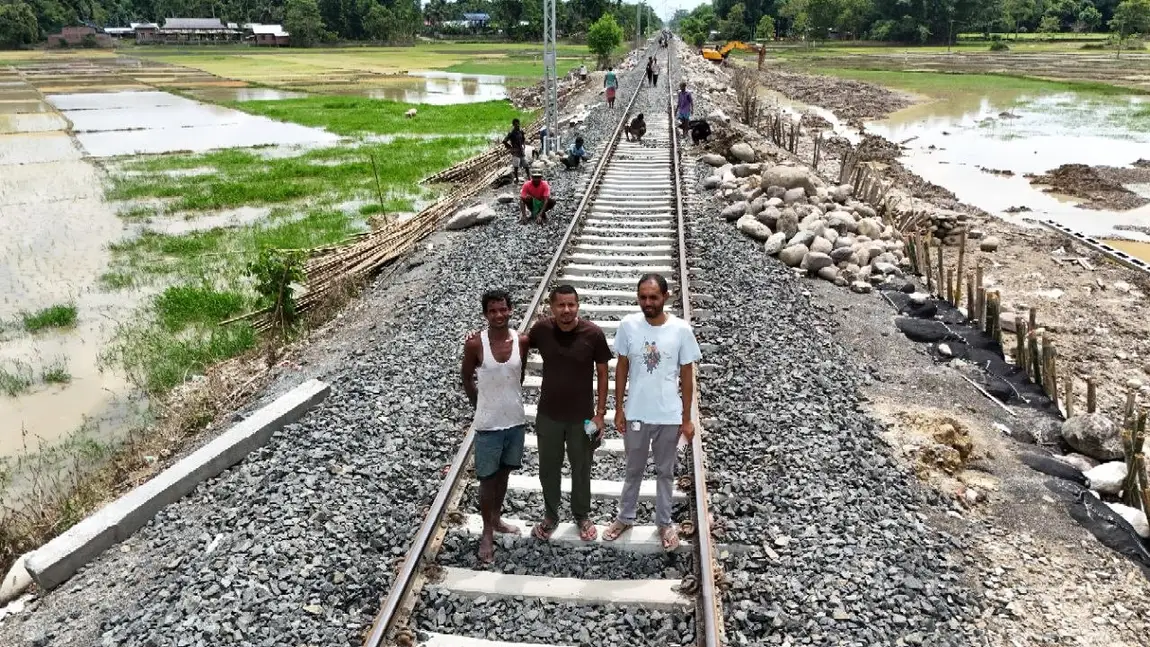
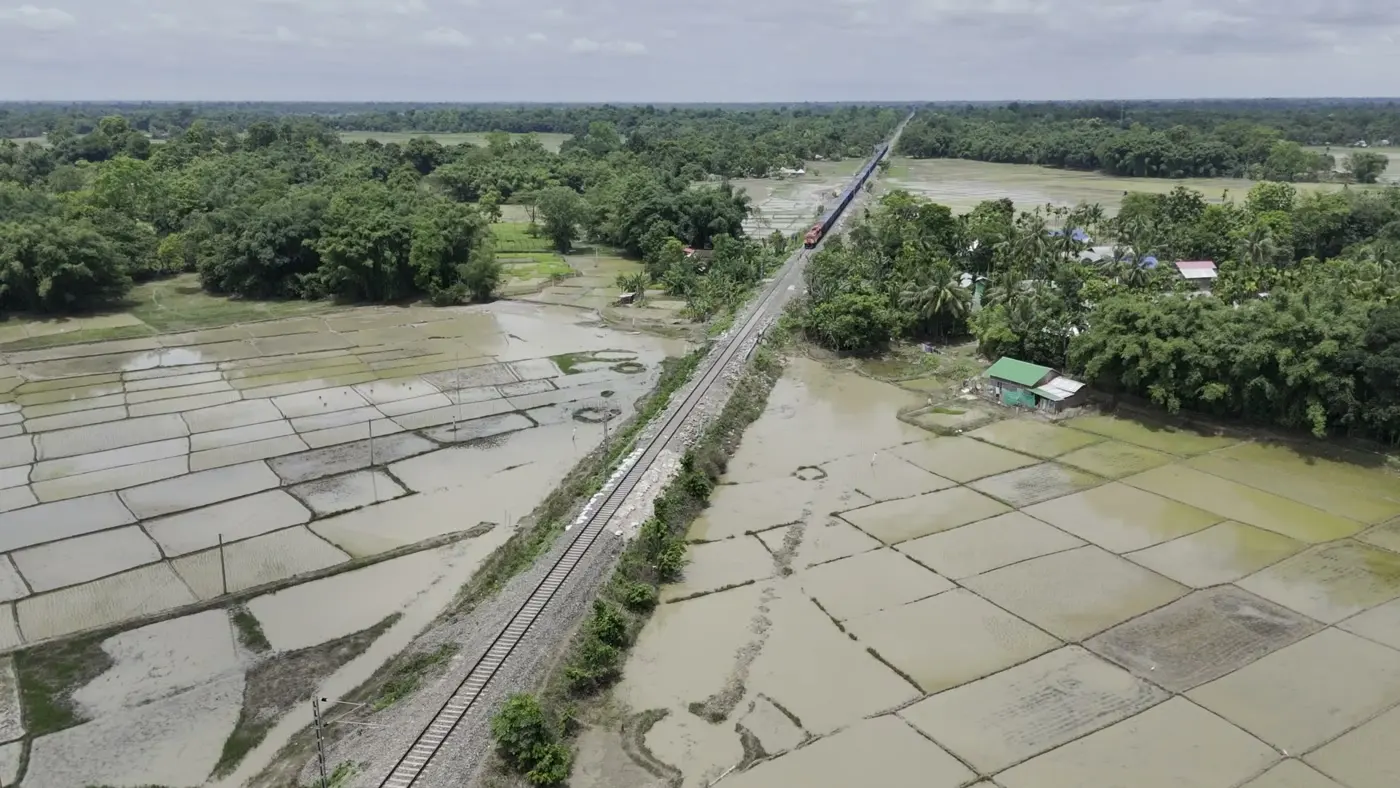
Aerial view of a railway embankment in flood-hit Assam with silted and waterlogged paddy fields on both sides

Home  /  Media & Blog  /  Floods, dropouts and skilling

Long read · Education & disaster recovery

The flood takes a season. Dropping out takes the rest of a life.

Schools in India’s flood-prone districts close for three to six months at a stretch. What happens in that gap, and what two decades of disaster-recovery research says about the help that actually holds.

What the evidence says

  • Among rural Indian children aged 8–11, living in a flood-exposed village is associated with about 0.14 standard deviations lower maths and 0.12 lower reading. Where flooding is frequent state-wide, the reading gap widens to roughly 0.26.[1]
  • Schools in flood-prone districts close for three to six months. The 2017 monsoon alone damaged or destroyed more than 18,000 schools across India, Bangladesh and Nepal, keeping 1.8 million children out of class.[1][2]
  • The exit from school is financial, not educational. After the 2008 Kosi floods in Bihar, child marriage rose 6.9 percentage points for boys and 3.6 for girls, and secondary completion fell.[5]
  • The most repeated finding in post-disaster recovery: cash and equipment rebuild a livelihood only for people who already held the skill. Everyone else gets an asset they cannot use.[8]
Sivasagar, August 2026

The disaster is not the water

In August 2026 our team spent time in Sivasagar and Charaideo in Assam, in villages where the flood had already receded. The lanes were walkable. The railway embankment had been packed back with bamboo piling where the ballast washed out. From the road it looked like the emergency was over.

It was not. The paddy was under silt. Nobody in those houses had earned anything that month, and several would not earn for the next three. None of that photographs well, which is part of why it gets missed, and it is what decides what happens to the children inside the house. Our record of the visit is here; it is a record rather than an appeal, on purpose.

The water itself lasts about a week. The recovery takes closer to eighteen months, and almost everything that decides whether a fifteen-year-old finishes school happens in that second stretch, in conversations no relief convoy is present for.

18,000+Schools damaged or destroyed, 2017 South Asia monsoon
1.8mChildren kept out of class by that single season
3–6 monthsTypical school closure in India’s flood-prone districts
What has been measured

What happens to learning when the school closes

The most careful study of this in India follows the same children over time. Nazar Khalid, Jere Behrman, Emily Hannum and Amrit Thapa used the India Human Development Survey panel to track rural children aged 8 to 11, and found that a third of them lived in villages exposed to floods between 2006 and 2011.[1]

Children in flood-exposed villages scored around 0.141 standard deviations lower in maths and 0.118 lower in reading. Where flooding was frequent across the whole state, the reading gap reached 0.255. Grade progression suffered too. Household income and parental schooling softened the effect, so the children in the poorest households absorbed most of it.

A seventh of a standard deviation sounds small, and for one year it is. But a child in Dhemaji, Majuli or Supaul is exposed most years of their schooling, and the gaps stack. The study names the mechanisms plainly: closures of three to six months, damaged buildings, broken transport, more demand for a child’s labour at home, and the aftermath of what they watched happen.

And the scale is regional. In the 2017 monsoon, Save the Children counted more than 18,000 schools destroyed or damaged — over 12,000 in India, 4,000 in Bangladesh, 2,000 in Nepal — with 1.8 million children unable to reach a classroom.[2] In Assam in 2026, Jorhat district alone reported 360 educational institutions affected, 125 of them severely damaged; the state resumed teaching on 10 August by moving children into relief camps and neighbouring schools.[3][4]

Those arrangements matter. They also do not touch the thing that does the lasting damage, which is simply time: the longer a child is out of school after a disaster, the less likely they are to go back at all.

Where the decision is actually made

Nobody decides to end their child’s education

Ask any family in a flood-hit village whether education matters and you get the same answer you would get anywhere. What changes after a flood is the household budget: the crop is gone, the goats are gone, the house needs a roof, a moneylender is owed, and there is a fourteen-year-old who could be earning instead of costing.

The consequences of that arithmetic have been measured. After the Kosi river floods in Bihar in 2008, the incidence of child marriage rose by 6.9 percentage points for boys and 3.6 points for girls. Those who married early completed less secondary schooling, and married women ended up with less control over money in their own households.[5] A wedding is cheaper than a school year, and it is one fewer person to feed.

Three residents standing on a raised railway line in flood-hit Assam, the ballast washed out and packed back with bamboo piling, flooded paddy fields on both sides
Mautgaon, Sivasagar district, August 2026. The embankment was repaired within weeks. The paddy on both sides was not.

The other route out is the road. NITI Aayog treats Assam as a high-risk state for climate-driven displacement, and the pattern reported from the Brahmaputra valley is consistent: people who lose land-dependent work leave for cities and take whatever manual labour is going, with women in particular exposed to exploitative conditions and, at the far end, trafficking.[6]

So a boy leaves for Guwahati or Delhi without a certificate and takes the first thing offered. A girl is married to take a cost off the household. Both are decisions made by people short of money inside a particular twelve-month window, and unlike most things about a flood, the timing of that window is predictable a year ahead.

A flood does not decide who drops out. A household budget does.
The price of the missing months

What a year out of school costs, in money

The largest attempt anyone has made to price time away from learning is about the pandemic rather than about floods. We cite it because it measures the same mechanism with much better data, not because the numbers carry over neatly to a river.

The World Bank, UNESCO and UNICEF estimated in December 2021 that the generation of students affected by school closures risks $17 trillion in lifetime earnings in present value, around 14 per cent of global GDP. For a typical student that works out to roughly $872 a year, about $16,000 across a working life in the intermediate scenario. Effective years of quality-adjusted basic schooling fall from 7.8 to somewhere between 6.7 and 7.5.[7]

Hold that beside a district where the school closes for four months most years. The rupee figure will not transfer. The mechanism does: months out of a classroom turn into lower earnings decades later, long after anyone has stopped covering the flood.

What history actually shows

Three disasters, and the same lesson each time

Post-disaster recovery has been evaluated often enough now to show a pattern, and the pattern is about who can actually use what arrives.

Aceh · 2004

The warning

After the Indian Ocean tsunami, governments and donors distributed millions of dollars of boats, tools, cash and machines. A field study built on 183 interviews and 38 focus groups found the aid did stabilise household finances and partly restored what people had been doing before.

But the packages were, in the researchers’ words, generally unable to build full-time, sustainable new livelihoods for people who lacked training and experience before the disaster.[8]

A boat given to a fisherman is a livelihood. A boat given to someone who has never fished is a boat.

Nepal · 2015

The proof

Rebuilding after the Gorkha earthquake needed masons who could build to a safer standard, and there were not enough. So they were trained. Oxfam ran seven-day upgrading courses for people already in construction and fifty-day on-the-job courses for people entering it, ending in a Level 1 certificate from Nepal’s Council for Technical Education and Vocational Training. In Gorkha district alone that meant 1,605 masons and 1,012 labourers.[9]

Under the National Reconstruction Authority’s housing programme, 149 women were hired as mobile masons across 14 districts, about a fifth of all those recruited. Durga Bhatta, working in Rasuwa, put it this way: “Villagers now consider us engineers as we are informing local people about resilient construction techniques.”[10]

Reconstruction created demand for one specific skill, and the people who got certified were the ones able to sell it.

Gujarat · 2001

The pattern

After the Bhuj earthquake, relief agencies put tools and raw materials back into the hands of 2,500 artisan families so they could restart trades they already knew, and trained women in construction work that had been closed to them until the rebuild created the opening.[11]

Reconstruction spending rewrites a local labour market from outside it, for a while. Who benefits depends on what people can already do when the money lands.

Recovery spending arrives on its own schedule. It does not wait for anyone to go and get qualified.

Different disasters, separate bodies of research, the same finding each time: a skill is the one thing a household keeps. The house, the paddy, the goats, the schoolbooks and the certificate in the steel almirah are all on the wrong side of the water. And the skill has to be there before the recovery money arrives, or the money flows past the people it was meant for.

Fitting the constraint, not the brochure

Why a free course on a phone is the right shape for a flood zone

Most skilling is designed for a room: a centre, a batch, a timetable, a trainer, a six-month commitment. A flood-hit district can supply none of those for about a year after the water. So the question worth asking is a narrow one: what can still reach a seventeen-year-old whose school has no roof and whose family has no income?

It needs no building

The binding constraint after a flood is physical: the roof, the desks, the road, the bridge. A course that lives on a phone is indifferent to all four. A student sitting in a relief camp is not disqualified from starting one.

It needs no timetable

Recovering households cannot hold a schedule. Somebody is always queuing, repairing, or away looking for work. Short modules taken at eleven at night in twenty-minute pieces survive that; a fixed 10am batch does not.

The phone is already there

Rural India now accounts for about 57 per cent of the country’s active internet users, roughly 548 million people out of 958 million.[12] In most flood-hit households the phone is one of the few things that leaves with the family.

The certificate travels

Flood-hit young people migrate. That is not a failure of the response, it is what the household does. Migrating with a documented skill is a materially different journey from migrating without one: it is the difference between choosing a job and taking the first one offered at a labour chowk.

What we actually run

Humrahi Foundation is a partner institute of the Skills Development Network, supported by the Wadhwani Foundation, and the programme we offer is free. It is twelve modules of employability skills: an introduction to employability, speaking, writing for work, interview preparation, self-management, working with people you did not choose, problem solving, workplace conduct, customer handling, digital productivity tools, digital safety, and an introduction to artificial intelligence. It runs on an ordinary smartphone and ends in a certificate.

It is open from Class 9 upwards: school students, college and ITI students, first-time job-seekers, and people already working who want to move up. None of it assumes an intact school building. You can read the full programme and module list here, and if you work with young people in a flood-affected district of Assam, there is a page written for partners like you.

The course is free to every student who takes it. Getting it to a village that has just lost a harvest is the part that costs money.

What this does not fix

The honest limits

A short course is not a cure for a flood, and this piece would be worth less if it pretended otherwise. Two findings keep us honest about what it can do.

The first is Aceh again. Training that is not connected to a real market does not become an income. What we teach is general employability rather than a trade. It makes somebody hireable; it does not hand them a job.

The second comes from India’s own flagship rural skilling programme. In a randomised study of DDU-GKY trainees, adding two sessions of concrete information about placement opportunities made people 18 per cent more likely to stay in the jobs they were placed in.[13] The follow-up moved the outcome more than the curriculum did.

Which is why our second step is a person rather than a page. Once you have registered, you message us on WhatsApp and someone from Humrahi stays in touch through the course. It is the least sophisticated part of the design, and on the evidence it is the part that matters most.

Support this

Fund the part that is not free

The twelve modules cost a student nothing, and they never will. What costs money is everything that happens before a student ever opens them: the travel to a block nobody has visited, the phone calls to a family that has just lost a harvest, the volunteer who sits in a courtyard and explains what a certificate is worth.

That work has no photograph attached and no emergency around it, which is exactly why it goes unfunded. A relief appeal writes itself six days after a flood. This is the ask six months later, when the household is quietly deciding whether the fifteen-year-old goes back.

Or give another amount. Payments are handled by Seva Stack, and gifts made through these links are tagged to our Free Education & Skilling project rather than to general funds. Donations to Humrahi Foundation carry 50 per cent tax exemption under Section 80G, and your 80G receipt is issued automatically. Every rupee is tracked; our certificates, accounts and reports are published on the transparency page.

Not in a position to give? Two things help nearly as much. Send the course to somebody who needs it, or, if you run an NGO, a school, a college or an ITI in a flood-affected district, take it to them yourself — there is a page written for partners, and no fee, MoU or money changes hands. Students can start at the programme page.

A flood is loud and a dropout is silent, which is why one gets covered and the other does not. Six months after the water goes down there is no camera present when a fifteen-year-old stops going. What prevents it is not dramatic either: a free course, on a phone the family already owns, taken in the months when the school cannot open.

Questions we get asked

Floods, school and skilling

Why do children drop out of school after a flood?
Rarely because of the water itself. Schools in flood-prone districts of India close for three to six months, and in that gap the household absorbs the loss: assets gone, a crop lost, debt taken on. Children get pulled into earning, or married early to cut costs. The longer a child is out, the less likely they are to return, so a season of closure quietly becomes a permanent exit.
How much learning do floods actually cost?
A 2024 study of rural Indian children aged 8 to 11, using the India Human Development Survey panel, found that living in a flood-exposed village was associated with roughly 0.14 standard deviations lower maths performance and 0.12 lower reading. Where flooding was frequent at state level, the reading gap widened to about 0.26 standard deviations.[1]
Does skill training help after a disaster, or is relief enough?
Relief keeps people alive; it does not restore an income. Research on Aceh after the 2004 tsunami found that livelihood aid stabilised household finances but generally could not build full-time, sustainable new livelihoods for people who lacked training and experience before the disaster.[8] Equipment and cash turn into a living only in hands that already know a trade. That is the argument for putting the skill in place before the money arrives.
Who can take Humrahi’s free skilling course?
Anyone from Class 9 upwards: school students, college and ITI students, people looking for a first job, and people already working who want to move up. It is free, runs on an ordinary smartphone, and ends in a certificate. Humrahi Foundation is a partner institute of the Skills Development Network, supported by the Wadhwani Foundation. Full details here.
What is in the course?
Twelve modules of employability skills: an introduction to employability, spoken communication, written communication, interview preparation, self-management, working with others, problem solving, workplace conduct, customer handling, digital productivity tools, digital safety, and an introduction to artificial intelligence.
Do you need a laptop or good internet?
No. It is built for a phone, and the modules are short enough to take in pieces rather than in one sitting. Rural India now makes up about 57 per cent of the country’s active internet users, and in most flood-hit households the phone is one of the few things that leaves with the family.[12]
Sources

Everything cited above

  1. Khalid, Nazar, Jere Behrman, Emily Hannum and Amrit Thapa. 2024. “Floods and Children’s Education in Rural India.” RSF: The Russell Sage Foundation Journal of the Social Sciences 10(1): 230–54. rsfjournal.org
  2. Theirworld, reporting figures from Save the Children, 31 August 2017: “South Asia floods: 18,000 schools damaged and fears that thousands of children may never go back.” theirworld.org
  3. The Assam Tribune, 2026: “Assam begins restoring flood-hit schools; 360 institutions damaged in Jorhat.” assamtribune.com
  4. The Hans India, 2026: “Assam to resume classes in flood-hit districts from Aug 10, alternative arrangements for damaged schools.” thehansindia.com
  5. “Do Marriage Markets Respond to a Natural Disaster? The Impact of Flooding of the Kosi River in India” (2023), listed by the World Bank’s Connect4Impact. connect4impact.worldbank.org
  6. EastMojo, 16 September 2020: “How floods and migration in Assam link to human trafficking.” eastmojo.com
  7. World Bank, UNESCO and UNICEF, 6 December 2021: “Learning losses from COVID-19 could cost this generation of students close to $17 trillion in lifetime earnings.” worldbank.org
  8. “Rethinking relief, reconstruction and development: Evaluating the effectiveness and sustainability of post-disaster livelihood aid,” International Journal of Disaster Risk Reduction. sciencedirect.com
  9. Oxfam in Nepal: “Oxfam producing skilled masons for reconstruction.” nepal.oxfam.org
  10. Sulochana Nepali, World Bank End Poverty in South Asia blog, 16 December 2020: “In Nepal’s post-earthquake reconstruction, women masons are breaking gender barriers.” blogs.worldbank.org
  11. “Gujarat earthquake response programme of Oxfam GB,” ReliefWeb. reliefweb.int
  12. Internet and Mobile Association of India (IAMAI), Internet in India 2025 report, released January 2026, as reported by BestMediaInfo. bestmediainfo.com
  13. “Can information about jobs improve the effectiveness of vocational training? Experimental evidence from India,” Journal of Development Economics (2024). sciencedirect.com

Casualty and damage figures from an ongoing disaster are revised often and sources disagree. Where a number is dated above, that is the figure as reported on that date, not a final count.

Read next

Where this work goes

Where the money goes

Registrations, audited accounts and reports, published in full. Transparency →

What it funds

The twelve modules, who they are for, and how a student starts. The programme →

Assam, for partners

If you reach young people in a flood-affected district. Partner with us →

Sivasagar, August 2026

The record of the field visit this piece opens with. What we saw →