
Home / Assam Flood Relief
Assam floods 2026 · the record so farAssam floods 2026: three days in Sivasagar.
Upper Assam went under in the third week of July. In August, seven of us drove to Mautgaon in Sivasagar and spent three days there with the Nine Story Foundation. The response is finished. This page is the record of it: what the team did on the ground, the photographs they came back with, the official figures, and what the work turned into afterwards.
Closed · last updated 27 August 2026. Humrahi's field team was in Mautgaon, Sivasagar, 15–17 August 2026, and relief kits reached more than 300 families. The Assam appeal and goods collection are no longer running; this page is kept as the record.
Nepal, 26 August 2026: a glacier collapse has destroyed the Bhotekoshi valley. Our Nepal appeal is here →
12A & 80G registered · your 80G receipt is emailed automatically · registrations & accounts
Three days in Mautgaon, Sivasagar
Seven Humrahi volunteers travelled to Mautgaon, in Sivasagar district, and worked out of the Nine Story Foundation communication office from 15 to 17 August 2026. Nine Story ran the distribution and knew which families needed what — the point of working with them was reaching the households in the most need, especially people with disabilities and families who had not yet received any relief; we came with hands, supplies and a drone. What follows is what we saw and what we did, in the order it happened.
What the embankment looked like from above
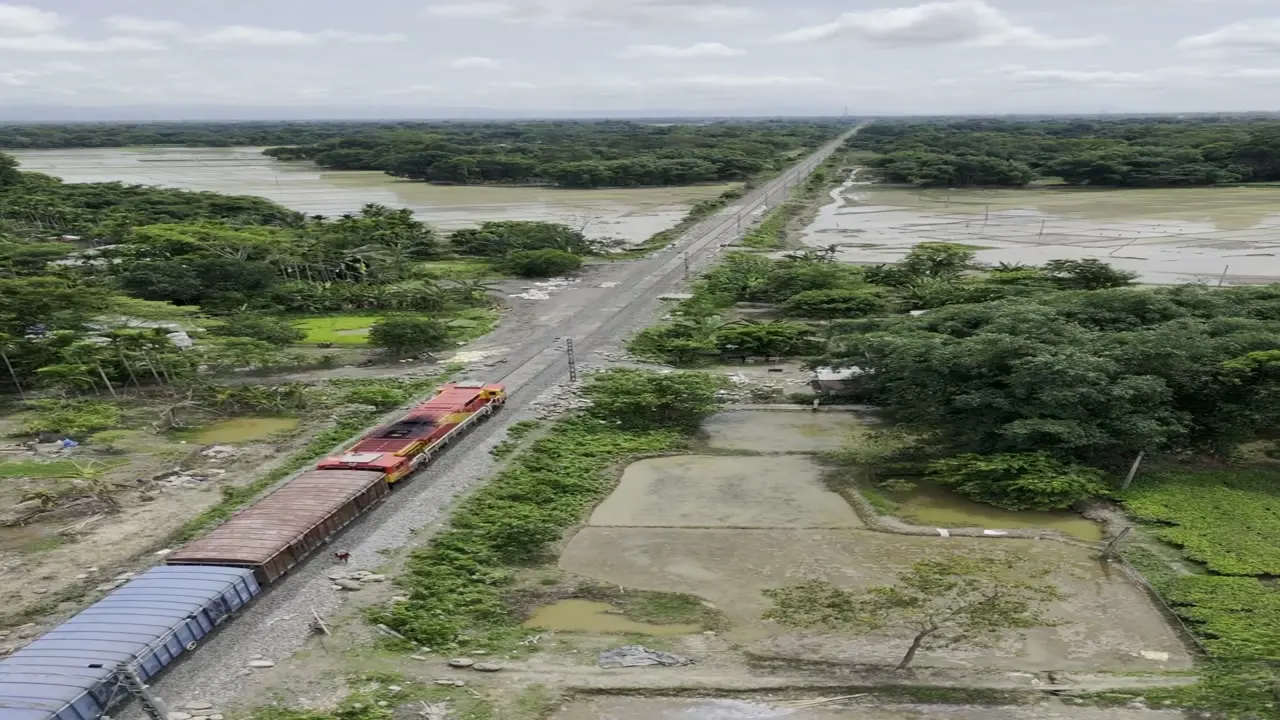
Before anything was handed out, we flew the railway embankment that runs through Mautgaon. It is the clearest way to understand this flood: the line sits above the water, and on both sides the paddy is either still submerged or buried under a layer of silt that will not grow anything this season. In places the ballast under the track had washed out and been packed back with bamboo piling.
Drone survey along the railway embankment at Mautgaon, 16 August 2026. The freight line kept running; the fields either side did not. Humrahi Foundation.
The plastic the flood left behind
The second thing that becomes obvious on the ground is the waste. Families in the affected belt had been drinking packaged water for weeks because the local sources were not safe, and relief distribution itself arrives wrapped in plastic. The verges were dense with bottles and packaging.
Our team spent part of 15 and 16 August on a roadside cleanup alongside Midway Journey, the Guwahati waste-management collective, working the stretches around the distribution sites. That cleanup was one part of a much larger drive across Sivasagar and Charaideo run under the Assam Pollution Control Board, which The Assam Tribune reported on 19 August 2026 had recovered more than 1,200 kg of plastic for recycling. That total is the whole drive's, across both districts and several organisations. It is not ours alone. Our own share of it, recycled through Midway Journey, came to hundreds of kilograms of plastic — a separate figure from the 1,200 kg district total above, not a part of it.
Registration, and then a distribution that ran into the night
Households were registered at the Nine Story office before anything was handed out, and that is what made the distribution work: names were checked against a written register before a kit was issued, so the same family could not be counted twice and nobody was turned away for lacking paperwork they had lost in the water. Supplies came in by pickup and were sorted onto tables inside the shelter hall.
The main distribution ran after dark on 16 August, under the hall lights, and reached more than 300 families. Volunteers from APUN worked the line alongside the Nine Story team and ours.
What we found out that changed the plan
We went expecting to plan a second relief run. We came back convinced that would be the wrong thing to fund.
Houses are being rebuilt, and they are being rebuilt locally, by families, neighbours and existing state schemes, with materials and labour that are already there. That is not the gap. The gap is what happens over the next twelve months to a household whose paddy is under silt, whose earning member has no work until the next season, and whose children have already missed weeks of school. Emergency kits do not touch that. So this is where our Assam work turns.
Three days, as we found them
Every photograph on this page is our own, taken in and around Mautgaon between 15 and 17 August 2026. Click any frame to open it full size. Photographs of children, and the pages of the registration register, are deliberately not published.
The official record, as of 11 August 2026
Assam's flood figures come from the daily bulletins of the Assam State Disaster Management Authority (ASDMA). The toll, currently-affected and relief-camp figures below are drawn from the bulletin of 11 August 2026, the most recent official count available when this page was updated. The late-July peak figures are kept alongside them, each with its own date and citation. The flood has not simply receded: the toll rose from 87 to 101 in the week to 11 August and the count of affected districts went back up from 7 to 10, with Golaghat now the worst-hit. Three rivers are still above the danger mark and relief work is ongoing.
On the toll: the ASDMA bulletin issued on the night of 24 July put the toll at 61, including 14 deaths in the preceding 24 hours (seven in Charaideo, six in Sivasagar, one in Jorhat). Chief Minister Himanta Biswa Sarma stated the figure as 62 on 25 July 2026. The bulletin of 4 August 2026 put the cumulative toll at 87. As of the ASDMA bulletin of 11 August 2026 it stands at 101 (ASDMA via The Sentinel, 11 Aug 2026); Onmanorama reported it at 100 on 10 August 2026. Full source list is at the foot of this page.
Where the Assam work went
We went expecting to plan a second relief run, and came back convinced that would be the wrong thing to fund. Houses were being rebuilt locally, by families and neighbours and existing state schemes. What a household could not replace was the cropping season. So the emergency response was closed after the August visit rather than extended, and this page stopped being an appeal.
Two things carried on past it, both through work that already existed rather than anything announced for Assam. Our free skilling programme is open to any student in the country at no cost, Sivasagar included. And volunteers stayed on the roadside and distribution-site cleanups alongside Midway Journey, the Guwahati waste-management collective, with what was collected going to recycling vendors rather than back into the river.
A schooling strand was planned with Nine Story Foundation and never reached the point of having numbers to publish. We would rather write that down than leave a plan sitting here as though it were running.
A note on the coverage linked from this page: The Assam Tribune's report describes the district-wide cleanup drive and the organisations working under the Assam Pollution Control Board. It does not name Humrahi Foundation. We link it because it documents the drive our volunteers took part in, not as coverage of us.
This page is a record, not an appeal. The Assam collection closed in 2026. If the way we report our work is useful to you, our current work is supported here.
A cloudburst upstream, and then Upper Assam went under
This wave did not build slowly. Around 19–20 July 2026, heavy rain and a cloudburst in the upper catchment areas sent an exceptionally high discharge down the tributaries of the Brahmaputra. Chief Minister Himanta Biswa Sarma attributed eight embankment breaches in Jorhat district to that single surge. By 20 July, 16 districts and 794 villages were reported inundated, with 3,62,933 people affected and four deaths in Jorhat.
Within five days the picture had changed shape rather than simply grown. The count of affected districts settled at 12, but the number of people inside those districts more than doubled to 7.05 lakh, and the toll went from four to sixty-plus. Fourteen people died in the 24 hours before the bulletin of 24 July alone. That is the signature of a flood that arrived faster than people could move.
The worst-hit districts
Upper Assam has taken the brunt. As of the 25 July bulletin, Sivasagar was the worst affected with 3,48,555 people, followed by Charaideo with 1,88,404 and Jorhat with 1,26,793. The other affected districts were Golaghat, Dibrugarh, Hojai, Nagaon, Biswanath, Dhemaji, Sonitpur, Kamrup (Metro) and Karbi Anglong. Guwahati and the surrounding Kamrup districts saw urban flooding of a different kind. India Today NE reported 14,986 residents affected across ten localities and municipal wards on 25 July.
The rivers
It is the tributaries, not only the Brahmaputra itself, that have done the damage. On 21 July the Brahmaputra, Burhidihing, Disang and Dhansiri (South) were all in spate, and the Dikhow at Sivasagar had crossed its highest recorded flood level. As of 25 July, four gauging points were still reading above the danger mark: the Dikhou, the Dhansiri at two locations, and the Kushiyara.
The camps, and the forecast
By 25 July the state was running 363 relief camps and relief distribution centres across seven districts, sheltering 1,15,205 people. The Chief Minister acknowledged the same day that relief had still not reached roughly 80,000 people, about 50,000 in the Nazira constituency and 30,000 elsewhere in Sivasagar. Meanwhile the India Meteorological Department kept an orange alert in force over Assam and Meghalaya, forecasting heavy to very heavy rainfall through the last week of July, with isolated falls in the 115.6–204.4 mm band. In other words, the water has not been given a chance to drain.
Kaziranga
One piece of better news. Kaziranga National Park, which loses animals in most major flood years, was not in a flood situation as of 21 July 2026. Divisional forest officer Arun Vignesh reported four low-lying forest camps inundated, in the Agoratoli, Kohora, Bagori and Burapahar ranges, and drew a clear line between waterlogged camps and an actual flood. That could change with further rainfall, but as of this update the park's animals had been spared.
Who is on the ground, and what has been announced
The Army moved first. Four flood relief columns of the Red Shield Division, under Spear Corps, were deployed on 20 July 2026 into Sivasagar, Charaideo and Jorhat (at Nazira and Amguri, at Sonari, and across Jorhat district) with rescue boats, medical teams and engineering resources, under the name Operation Jal Rahat. By 22 July the Army had pulled more than 700 people out of the water. Two teams of the National Disaster Response Force's 1st Battalion had arrived on 19 July with twelve rescue boats for Jorhat and Golaghat, and had evacuated over 500 people from Jorhat by 24 July. In the 24 hours before the 25 July bulletin, the Army, NDRF, SDRF, Fire & Emergency Service, police and civil agencies together pulled out close to a thousand people, mostly from Jorhat and Sivasagar.
On the state side: 363 relief camps and distribution centres running across seven districts, an ex-gratia of ₹4 lakh announced by the Chief Minister on 22 July for the family of each person killed, and the Chief Minister himself touring Charaideo, Sivasagar and Jorhat through the week. Opposition leaders have contested the pace rather than the effort. See the section below.
From the Centre, as of 26 July there is no specific rupee figure on the table. Union Minister Sarbananda Sonowal announced on 24 July that a multi-disciplinary delegation from several central ministries would visit Assam to assess the damage, after which the Union government would extend special financial support for relief, rehabilitation and restoration. Prime Minister Narendra Modi telephoned the Chief Minister on 25 July to assure central support; the call was reported by the Chief Minister himself.
Where a small organisation fits
State machinery moves people out of the water. What it is slower at, as the Chief Minister's own 80,000-person gap shows, is the second week: dry clothes, blankets, sealed food, basic medicine, for families sitting in a camp with nothing but what they swam out in. That was the gap in July, and it is the gap Humrahi Foundation went to Sivasagar to help close. What we found when we got there in August changed our mind about what the next twelve months need. That is the field report, and the work it turned into.
Questions before you give? Ask us on WhatsApp or call +91 77977 07700.
Voices on the 2026 Assam floods
Assam CM Himanta Biswa Sarma spoke to India Today NE on 22 July 2026 after visiting flood-hit Charaideo district: "the damage is far greater than we had anticipated."
"There is a severe delay in delivering emergency rations, safe drinking water."
Quotes are short extracts, attributed to the outlet that carried them; links are in the sources list.
Assam flood relief: common questions
What did Humrahi actually do in Assam?
Seven Humrahi volunteers were in Mautgaon, Sivasagar district, from 15 to 17 August 2026, working with the Nine Story Foundation. We surveyed the flood damage along the railway embankment by drone and on foot, joined a roadside plastic cleanup alongside Midway Journey as part of the district-wide drive run under the Assam Pollution Control Board, and helped run a night distribution of relief kits that reached more than 300 families. The field report on this page sets out what happened, with our own photographs. Emergency distribution is now winding down; our Assam work is moving to livelihoods, schooling and continued cleanup.
How bad are the 2026 Assam floods?
As of the ASDMA bulletin of 11 August 2026, the toll stands at 101 lives, up from 87 on 4 August, with 1,26,431 people still affected across 10 districts, including Golaghat, Sivasagar, Nagaon, Jorhat, Charaideo, Karbi Anglong and Darrang. The late-July peak was 7.05 lakh people across 12 districts (ASDMA, 25 July 2026), but the situation has not simply eased: affected districts went back up from 7 to 10 in the week to 11 August, three rivers remain above the danger mark, and relief work continues.
Which districts of Assam are worst hit in the 2026 floods?
Upper Assam has taken the worst of it throughout the flood. As of the ASDMA bulletin of 11 August 2026, the worst-hit district is Golaghat (71,061 people affected), followed by Sivasagar (21,600), Nagaon (16,908), Jorhat (13,166) and Charaideo (2,539), with Karbi Anglong, Darrang, Hojai, Lakhimpur and Cachar also affected. At the late-July peak, Sivasagar had 3,48,555 people affected, Charaideo 1,88,404 and Jorhat 1,26,793 (ASDMA, 25 July 2026); the other districts affected then were Golaghat, Dibrugarh, Hojai, Nagaon, Biswanath, Dhemaji, Sonitpur, Kamrup (Metro) and Karbi Anglong.
Is Humrahi still collecting for Assam?
No. The Assam flood response closed after the August 2026 field visit, and the donation and goods collection that ran on this page have been taken down. The page is kept as the record of what was done, with its sources. Our current work, including any live relief appeal, is on the main site.
Where these figures come from
Every number on this page is taken from one of the reports below and carries its date. Where reports disagreed, we used the most recent official statement and said so. Nothing here is our own estimate, apart from the figures in our own field report, which are labelled as ours. Last checked 21 August 2026.
- Assam State Disaster Management Authority (ASDMA) daily flood bulletins — asdma.assam.gov.in
- The Sentinel Assam, "Assam floods claim 101 lives, over 1.26 lakh people still affected" — 11 August 2026 (ASDMA bulletin — cumulative toll, currently-affected districts, relief camps, rivers above danger level) — sentinelassam.com
- Onmanorama, "Assam flood death toll reaches 100, nearly 1.4 lakh remain affected" — 10 August 2026 (toll, affected, relief camps) — onmanorama.com
- Onmanorama, "Assam flood toll rises to 87 with 2 more deaths, 1.3 lakh still affected" — 4 August 2026 (ASDMA bulletin — cumulative toll, currently-affected districts, relief camps) — onmanorama.com
- Onmanorama, "Assam flood situation remains grim; toll rises to 61, over 7 lakh affected" — 25 July 2026 (ASDMA figures, relief camps, rivers above danger level)
- ANI / Sunday Guardian, "Assam floods: death toll rises to 61, 14 deaths in last 24 hours" — 25 July 2026 (district-wise figures, villages, cropland, livestock, rescues)
- India Today NE, "Assam flood death toll now stands at 62: Himanta Biswa Sarma" — 25 July 2026 (toll, urban flooding in Kamrup)
- EastMojo, "Upper Assam floods batter Sivasagar, Charaideo, Jorhat" — 21 July 2026 (cloudburst trigger, embankment breaches, river levels, 20 July figures)
- Business Standard, "Assam flood toll rises to 47, over 721,000 affected across 11 districts" — 24 July 2026
- Daily Excelsior — 23 July 2026 (₹4 lakh ex-gratia announced by the Chief Minister on 22 July)
- ANI, "Indian Army rescues over 200 civilians in flood-hit Upper Assam" — 21 July 2026, and The Shillong Times — 22 July 2026 (Red Shield Division flood relief columns, Operation Jal Rahat, rescue totals)
- NE India Broadcast — 24 July 2026 (NDRF 1st Battalion deployment, boats, rescues in Jorhat)
- Pro Kerala / ANI — 24 July 2026 (Sarbananda Sonowal statement, central team announcement) and 25 July 2026 (PM Modi's call to the Chief Minister)
- ANI, "President Murmu expresses grief over loss of lives in Assam floods" — 25 July 2026
- Outlook India — 23 July 2026 (Gaurav Gogoi on delays in relief delivery)
- India Meteorological Department, via Down To Earth daily weather tracker — 20 July 2026 (orange alert, heavy to very heavy rainfall outlook for Assam and Meghalaya)
- Assam Tribune — 21 July 2026 (Kaziranga National Park status, divisional forest officer Arun Vignesh)
- The Assam Tribune, "Over 1,200 kg plastic waste found in flood-hit Sivasagar, Charaideo; recycling on" — 19 August 2026, by Rituraj Borthakur (the district-wide plastic cleanup drive our volunteers took part in; the report names the Assam Pollution Control Board and refers to three NGOs, and does not name Humrahi Foundation) — assamtribune.com
- Humrahi Foundation field team, Mautgaon, Sivasagar — 15–17 August 2026 (volunteer count, families reached, activities in the field report; our own record)
- Video: India Today NE, Moneycontrol and DD India on YouTube, embedded in privacy-enhanced mode. Drone and ground footage on this page is our own.
Spotted something out of date? Email a@myhumrahi.org and we will correct it.